
Lead Reversion of Soluble Watercolors using Peroxide Gels
This article by Katie Boodle was first published in the SERCA Newsletter, Issue Spring 2021 Volume 4, Number 1, and is republished here with her permission.
To cite: Boodle, K. (2021). Lead Reversion of Soluble Watercolors using Peroxide Gels. SERCA Newsletter, Vol 4 – Number 1, pages 5-11. ISSN: 3069-6623
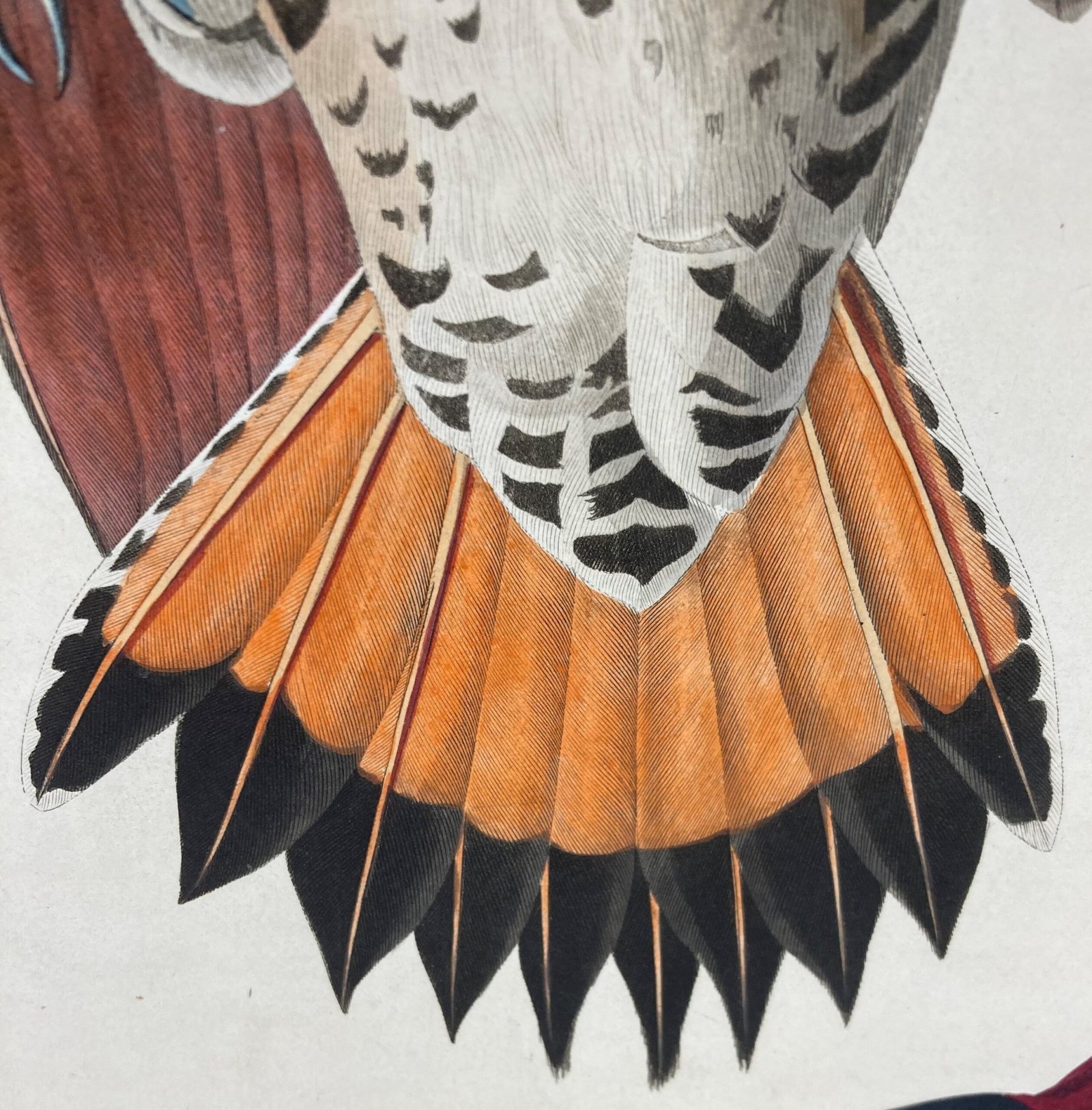
I wanted to share my recent experience with using peroxide gels to restore color to lead darkened pigments of soluble watercolors as a follow-up from the 2021 SERCA Annual Meeting Tips Session. The colors in question were some lead-based reds and oranges in Audubon’s Birds of North America. The colors had shifted from the intended color to a muddy or speckled brown giving the birds a jarring appearance in their otherwise vibrant plumage.
For quick reference, lead carbonate (Lead White) reacts with hydrogen sulfide—a VOC present in small quantities in the air—to form lead sulfide. This reaction is what causes the visual shift from a white color to a brown, grey, and/or black in our artwork. Traditionally, higher concentrations of hydrogen peroxide in ethanol or something like ethereal hydrogen peroxide are used to change lead sulfide into lead sulfate. This is not the same chemically as the original Lead White, but is a more stable version of the pigment and restores the visual cohesiveness of the work.
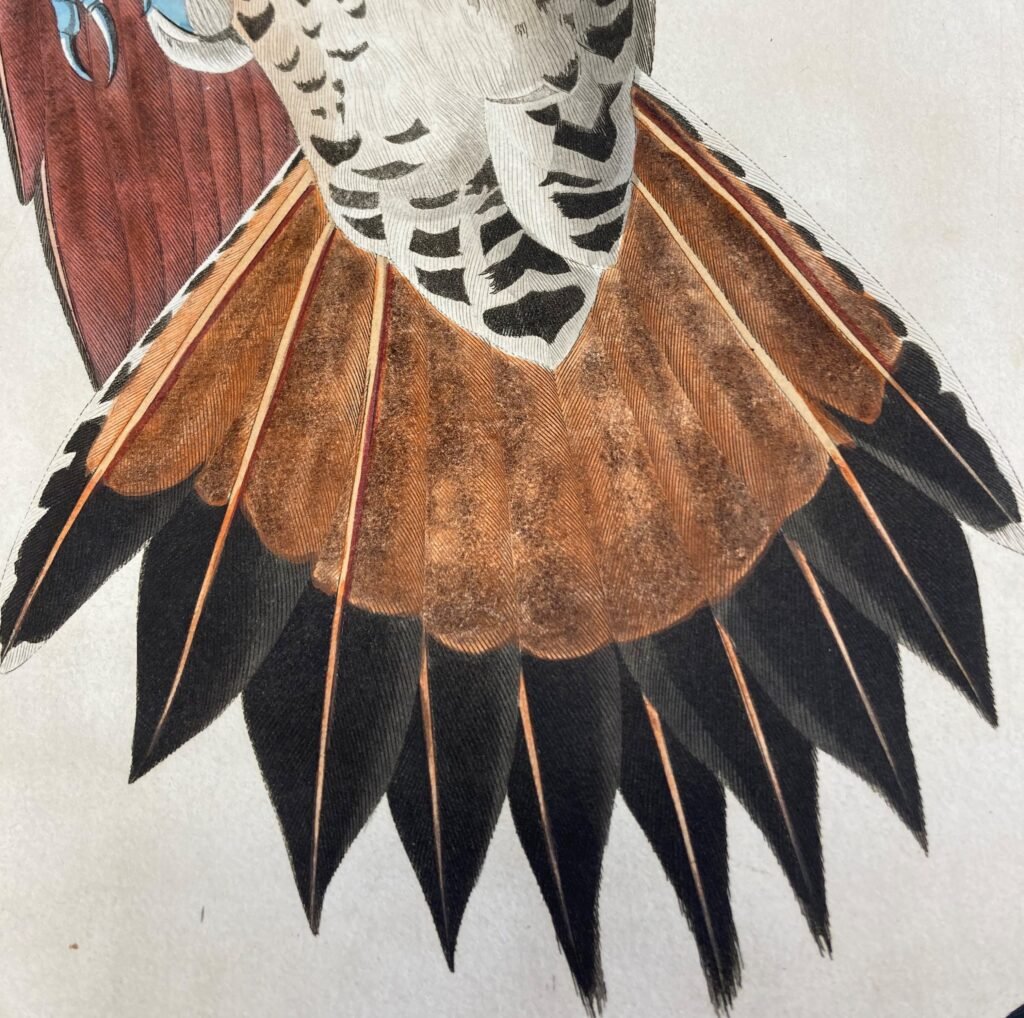
Addressing colored pigments that come from lead oxides—most common for us would be lead (II,IV) oxide–or colors that had had Lead White mixed in can be a bit more problematic, especially if those pigments appear as highly soluble watercolors. The mechanism for reversion is not as clear-cut as it appears to be for lead carbonate, though similar methods do prove successful.
If you do a quick search for information regarding how to address the lead darkening, you come across Margo McFarland’s 1997 article on using peroxide gels and a 2016 blog post by Denise Stockman on Lead White conversion from the New York Public Library. Stephanie Lussier also has an entry in the 2016 BPG Annual that does a good job of reviewing possible reversion techniques that includes SEM analysis of the treated areas. None of these articles address how to approach the lead oxides, though, and only Stockman even mentions uncertainty about how effective her method might be on those pigments.
As I wanted to avoid using and storing the very hazardous diethyl ether that would have been necessary to create the ethereal hydrogen peroxide, I decided to use the articles as a basis for testing possible techniques. As we were on a deadline to complete the work, I also had to come up with a solution quickly as well as one that would be safe for the surrounding colors.
It was decided to run the following tests:
- A brush application of a 7% hydrogen peroxide solution as a “control” on some stable Lead White.
- A 3% hydrogen peroxide in 3% methylcellulose along with ethanol as described by McFarland.
- A 7% hydrogen peroxide in a 5% agarose gel as described by Stockman. (Stockman didn’t specify her gel concentration, but this seemed like a good baseline given advice when testing with gels generally.)
As the colors were very soluble, I didn’t want to try to do any other brush applications on the reds or oranges as a comparison test. Additionally, while the articles indicated that you could just wick the peroxide solution away to remove any residues, it was decided that a controlled rinsing with deionized water in a 5% gel would be done as a precaution anyway just to be thorough.
After multiple comparison tests the rigid 5% gel won out. McFarland’s method of the 3% peroxide gel ended up causing too many issues with the soluble colors even when we applied it in a very thin coat as indicated in her article. The media became much more soluble thanks to localized swelling and even moved into the methylcellulose. On the Lead White that the brushed solution was applied to, it was determined that the areas got too wet to be of use for our reds and oranges. It was a concern that there would be some localized bleeding of the media if we chose to go that route.
Some things that I do want to note are, first, that Stockman mentioned in her post that the Lead White reversed in 3-5 minutes. However, we found that we had to keep the gels on the area for about 8-10 minutes for the orange colors and 10-12 minutes for the red. While it isn’t confirmed at this time, I believe that the difference in time has something to do with the chemical properties of lead oxides compared to lead carbonates and how they bind with the sulfur. Additionally, contact also seemed to play a big part in how effectively and quickly the oranges and reds reversed and sometimes multiple applications of the gels were needed to fully revert the color or at least get it to an acceptable level. And lastly, the gels needed to sit overnight and become fully saturated with the 7% hydrogen peroxide solution. An attempt was made to do the work all in one day, but we found that allowing the gels to fully absorb the solution overnight provided a more consistent and effective result when it was applied to the affected area.
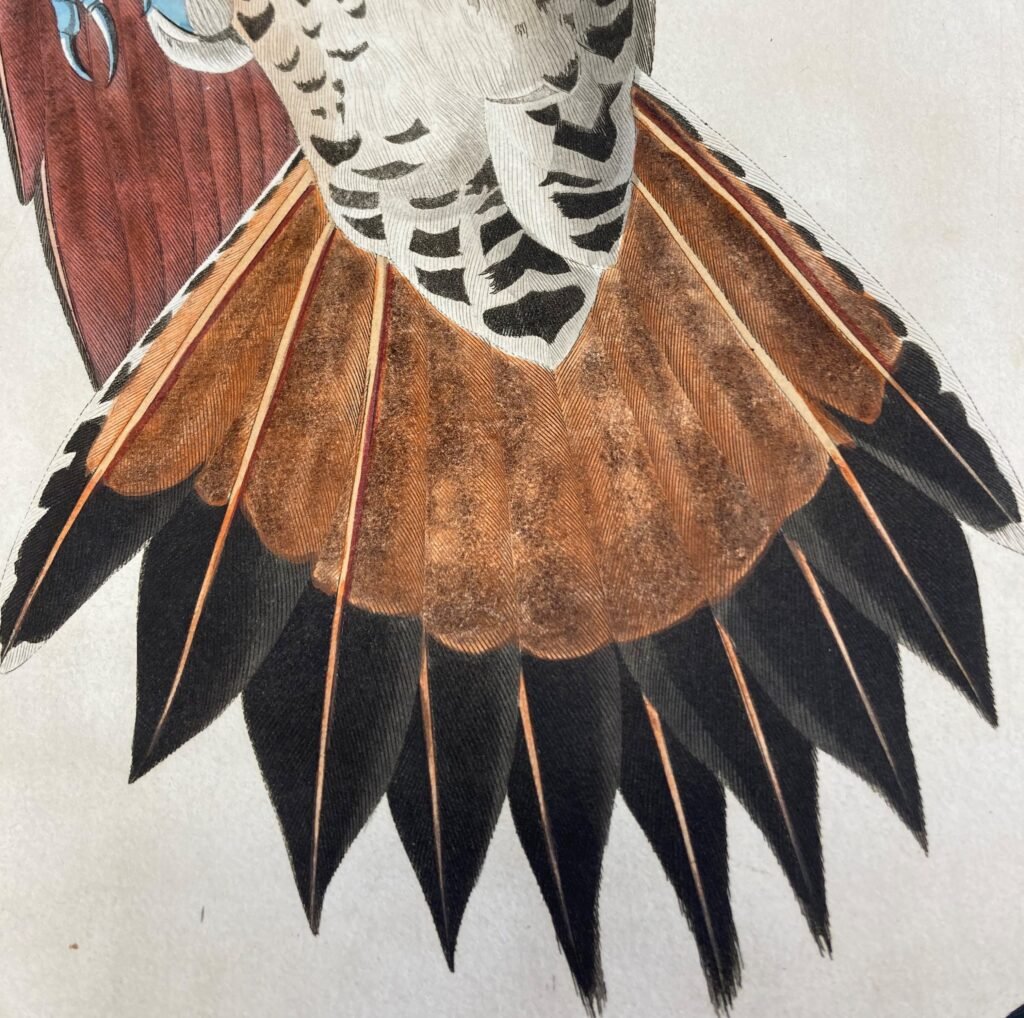
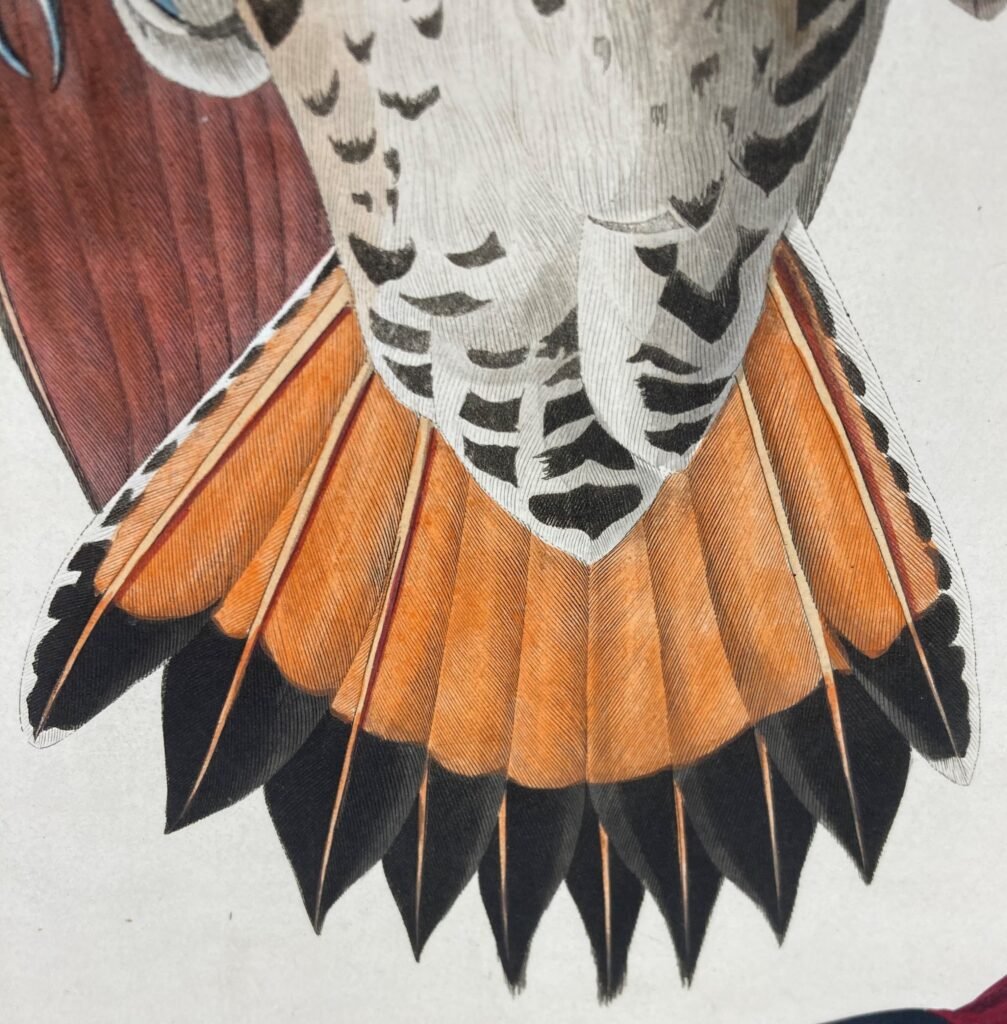
Before and After treatment of tail feathers
Instructions for the Creation and Use of the Peroxide Gels (Overnight Process):
- Make a 5% rigid gel by adding 5.0g of agarose to 100mL of deionized water in the manner recommended by Keynan and Hughes (source below). I’m not sure if gellan gum would also work, but I would welcome any feedback given the cost difference in the two materials.
- Once cooked, split the gel solution between two petri dishes or other small plastic containers. It should evenly split between two dishes and give you a gel that is about 10mm or just less than ½” thick.
- Once cooled completely, cover with DI water to both rinse and fully saturate the gel.
- After at least an hour, but ideally between 3-4, test the gels for clarity and rigidity by discarding the water and patting them dry with a paper towel.
- Mix up a 7% hydrogen peroxide solution—approximately 1:3, 30% peroxide: deionized water. This actually gives you a 7.5% solution, but you should expect that the water in the gels will dilute this slightly to the desired 7% solution.
- Mark your containers as “water” and “peroxide.” Cover each gel with the corresponding solution and allow them to soak overnight in the fridge.
- Remove the gels from the fridge and allow them to come up to room temperature (~1hr or so).
- Cut the peroxide gel to shape it to the affected area. Pat it as dry as possible to remove any excess peroxide solution before covering the gel with a piece of plexiglass, or other barrier material and a light weight.
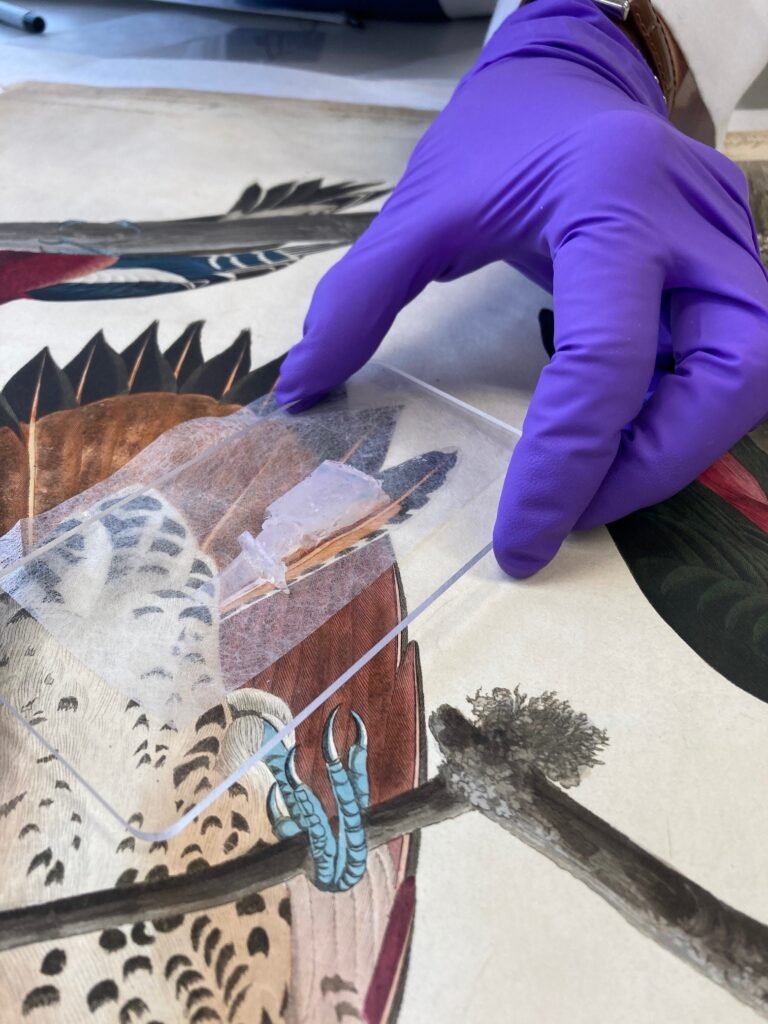
A rough rule of thumb from our experience: Lead White took between 3-5 minutes, Lead Orange took between 8-10 minutes, and Lead Red took between 10-12 minutes. Sometimes the oranges and reds required multiple applications of the gels or more weight as overall contact seemed far more important to make the reversion work.
- Remove any excess moisture from the solution if necessary by wicking it away with a small section of blotter.
- Repeat the shaping and application process with the deionized gel, remembering to pat it dry to prevent any media bleeding or transference. The rinsing gel should be on the area for at least the same amount of time as the peroxide gel.
- Dry the area locally under under local blotters and weights.
Sources and Further Reading:
Keynan, Daria and Amy Hughes. “Testing the Waters: New Technical Applications for the Cleaning of Acrylic Paint Films and Paper Supports.” Book and Paper Group Annual. Vol 32, 2013. Pp 43-51. https://cool.culturalheritage.org/coolaic/sg/bpg/annual/v32/bpga32-08.pdf
Lussier, Stephanie M. “An Examination of Lead White Discoloration and the Impact of Treatment on Paper Artifacts: A Summary of Experimental Testing.” Book and Paper Group Annual. Vol 25, 2006. Pp9-12. https://cool.culturalheritage.org/coolaic/sg/bpg/annual/v25/bpga25-03.pdf
McFarland, Margo R. “The Whitening Effect of Peroxide Gels on Darkened Lead White Paint.” Book and Paper Group Annual. Vol 16, 1997. https://cool.culturalheritage.org/coolaic/sg/bpg/annual/v16/bp16-08.htmlStockman, Denise.
“Inside the Conservation Lab: Lead White Conversion.” New York Public Library Blogs. 14 Nov 2016: https://www.nypl.org/blog/2016/11/14/inside-conservation-lab